
Most online work looks complicated because the internet organizes opportunities by job titles.
Freelancer. Virtual assistant. Digital marketer. Content creator. AI specialist. Copywriter. Designer. Automation expert.
Those labels can be useful, but they can also make the online economy feel like hundreds of unrelated paths.
SideHustleEmpireHQ uses a simpler map.
Instead of starting with job titles, we look at the useful result the work creates.
From that perspective, a large amount of digital work can be understood through four broad opportunity currents:
- Attention — helping something get discovered, noticed or understood.
- Operations — helping work stay organized and move properly.
- Acceleration — helping useful work happen faster or with less unnecessary effort.
- Value — helping something become clearer, more useful, trusted or valuable.
We call these the Four Currents of the Digital Ocean.
The Four Currents of the Digital Ocean

Attention
Get discovered, noticed or understood

Operations
Organize work and keep it moving

Acceleration
Make useful work faster or easier

Value
Make something clearer, useful or valuable
They are not four job titles or four careers. They are a way to understand where value is being created before deciding which skill, tool or income path to pursue.
Why Start With the Work Instead of the Job Title?
A job title tells you what someone is called. It does not always tell you why their work matters.
For example, two people might both call themselves virtual assistants while solving completely different problems. One may organize customer inquiries and schedules. Another may research content ideas and help publish them.
The title is the same. The useful result is different.
This is why the Four Currents begin with a different question:
“What becomes better because this work exists?”
Once you can answer that question, digital work becomes much easier to understand.
1. Attention: Helping Something Get Discovered, Noticed or Understood
Every useful business, idea, product or person has an attention problem before someone can act on what they offer.
People cannot buy something they never discover. They cannot understand an offer they never notice. And even when something gets seen, unclear communication can still prevent people from understanding why it matters.
This is the Attention Current.
Attention work helps something move from:
Examples of Attention work can include:
- Content creation
- Social media management
- SEO and search content
- Copywriting
- Email marketing
- Video editing
- Audience research
- Content distribution
But the important idea is not the job title.
A person editing short-form videos, writing search articles and managing a company’s social media may appear to have three different skills. Underneath them, however, they may be solving the same fundamental problem:
Helping the right people discover and understand something.
How a Beginner Can Recognize an Attention Problem
Look for situations where something useful already exists, but the right people are not seeing it, noticing it or understanding it.
A small business might have a good service but rarely post online. A creator might have useful ideas but struggle to turn them into clear content. A website might answer valuable questions but be difficult to discover through search.
Those are not simply “marketing jobs.” They are clues that an Attention problem exists.
The beginner’s question becomes:
“What could I help someone make easier to discover, notice or understand?”
2. Operations: Helping Work Stay Organized and Move Properly
Behind almost every business, project or creator is work that has to be organized, tracked and completed.
Messages need responses. Tasks need owners. Information needs somewhere to live. Customers need follow-up. Schedules need coordination. Processes need to keep moving even when nobody is watching them.
This is the Operations Current.
Operations work helps something move from:
Examples of Operations work can include:
- Virtual assistance
- Inbox and calendar management
- Customer support
- Research
- CRM organization
- Project coordination
- Documentation
- Data and information management
Again, the job title is not the most important part.
A virtual assistant organizing an inbox, a project coordinator tracking deadlines and someone cleaning up a company’s CRM may appear to be doing very different jobs.
Underneath them is a similar useful result:
Helping important work stop getting lost, delayed or disorganized.
How a Beginner Can Recognize an Operations Problem
Look for situations where work already exists, but something keeps slipping through the cracks.
A business might receive customer enquiries but respond too slowly. A founder might keep important tasks scattered across messages and notes. A small team might repeatedly search for information because nobody has organized it properly.
Those are clues that an Operations problem exists.
The beginner’s question becomes:
“What could I help someone organize, track or keep moving?”
3. Acceleration: Helping Useful Work Happen Faster or With Less Effort
Sometimes the problem is not that work is missing or disorganized. The work already happens — it simply takes too much time, repetition or unnecessary effort.
This is the Acceleration Current.
Acceleration work looks for ways to reduce friction while preserving or improving the useful result.
It helps work move from:
Examples of Acceleration work can include:
- AI-assisted workflows
- Automation
- No-code systems
- Workflow design
- Process improvement
- Templates and reusable systems
- Data processing
- Tool integration
This is where beginners can easily confuse the tool with the opportunity.
Knowing ChatGPT, Zapier, Notion or an automation platform can be useful. But a business does not necessarily need another tool. It needs something that becomes easier, faster or less repetitive because of that tool.
For example, automatically moving a new enquiry into a CRM, assigning a follow-up task and preparing a response can reduce several manual steps.
The useful result is not simply “automation.”
The useful result is less time and effort required to keep important work moving.
How a Beginner Can Recognize an Acceleration Problem
Look for work that people repeatedly do by hand, processes that contain unnecessary steps, or tasks that consume far more time than the result should require.
A founder might copy the same information between different tools every day. A team might manually prepare the same type of report every week. A creator might repeat the same publishing steps for every piece of content.
Those are clues that an Acceleration problem may exist.
The beginner’s question becomes:
“What useful work could I help someone make faster, simpler or less repetitive?”
4. Value: Helping Something Become More Useful, Clear, Trusted or Valuable
Some work does not primarily create attention, organize operations or make a process faster. Instead, it improves the quality, usefulness or perceived value of something that already exists.
This is the Value Current.
Value work asks how an idea, product, service, decision or experience can become better for the person who receives it.
It helps something move from:
Examples of Value work can include:
- Design
- Research and analysis
- Strategy
- Offer improvement
- Sales support
- Consulting
- User experience improvement
- Product or service improvement
A designer making an offer easier to understand, a researcher helping a founder make a better decision and a strategist improving how a service is positioned may appear to be doing unrelated work.
But underneath them is a similar useful result:
Helping something become clearer, more useful, more trusted or more valuable.
How a Beginner Can Recognize a Value Problem
Look for situations where something already exists, but it could work better, communicate its value more clearly or create a better result for the person using it.
A business might have a useful service but an offer that is difficult to understand. A website might receive visitors but make the next step confusing. A founder might have plenty of information but need help turning it into a useful decision.
Those are clues that a Value problem may exist.
The beginner’s question becomes:
“What could I help someone make clearer, more useful, more trusted or more valuable?”
The Four Currents are not four careers you must choose between.
They describe what kind of useful change is happening. A single project, role or business problem can move through several currents.
Imagine a small business that receives enquiries online but keeps losing potential customers.
The problem might move through the Digital Ocean like this:
- Attention: Help more of the right people discover and understand the business.
- Operations: Organize incoming enquiries so none are forgotten.
- Acceleration: Automate repetitive parts of the follow-up process.
- Value: Improve the offer or customer journey so the next step is clearer and more useful.
One business problem can therefore create opportunities across several currents.
This also explains why the same skill can have different value in different situations.
Writing might create Attention when it helps an article get discovered, but it might create Value when it makes a confusing offer easier to understand.
AI might support Acceleration by reducing repetitive work, but it could also support Operations by helping organize information.
The tool does not determine the current.
The useful result does.
This is why SideHustleEmpireHQ does not treat digital skills as isolated things to collect. Skills become meaningful when they connect to a problem someone actually wants solved.
How to Find Your Starting Current
You do not need to decide which Current will define your entire career.
You only need somewhere useful to begin.
Instead of asking which Current sounds most impressive, pay attention to the kinds of problems you naturally notice.
You may lean toward Attention if…
- You notice when useful things are difficult to discover.
- You enjoy explaining ideas, creating content or communicating clearly.
- You often think about how something could reach the right audience.
Ask: “What could I help someone make easier to discover, notice or understand?”
You may lean toward Operations if…
- You notice when information, tasks or communication are disorganized.
- You enjoy organizing, coordinating or keeping things on track.
- You naturally see missing steps and things falling through the cracks.
Ask: “What could I help someone organize, track or keep moving?”
You may lean toward Acceleration if…
- You notice repetitive work and unnecessary steps.
- You enjoy finding faster or simpler ways to complete tasks.
- You are curious about AI, automation, systems or tools.
Ask: “What useful work could I help someone make faster, simpler or less repetitive?”
You may lean toward Value if…
- You notice when something useful is confusing, weak or difficult to trust.
- You enjoy improving ideas, offers, experiences or information.
- You naturally ask how something could become clearer or more useful.
Ask: “What could I help someone make clearer, more useful, more trusted or more valuable?”
You may recognize yourself in more than one Current. That is normal.
Your goal is not to find your permanent label. Your goal is to find your first useful direction.
Turn Your Current Into a Small Experiment
Understanding your Current is only the beginning. The next step is to test it against a real problem.
You do not need a client, a job or years of experience to begin.
Choose one small problem connected to your Current and try to create a useful result.
For example:
- Attention: Take a useful but poorly explained idea and turn it into a clearer social post.
- Operations: Take scattered information and organize it into a simple tracker or checklist.
- Acceleration: Find a repetitive task and create a simpler process for completing it.
- Value: Take a confusing offer, page or message and make it easier to understand.
Then save what you created.
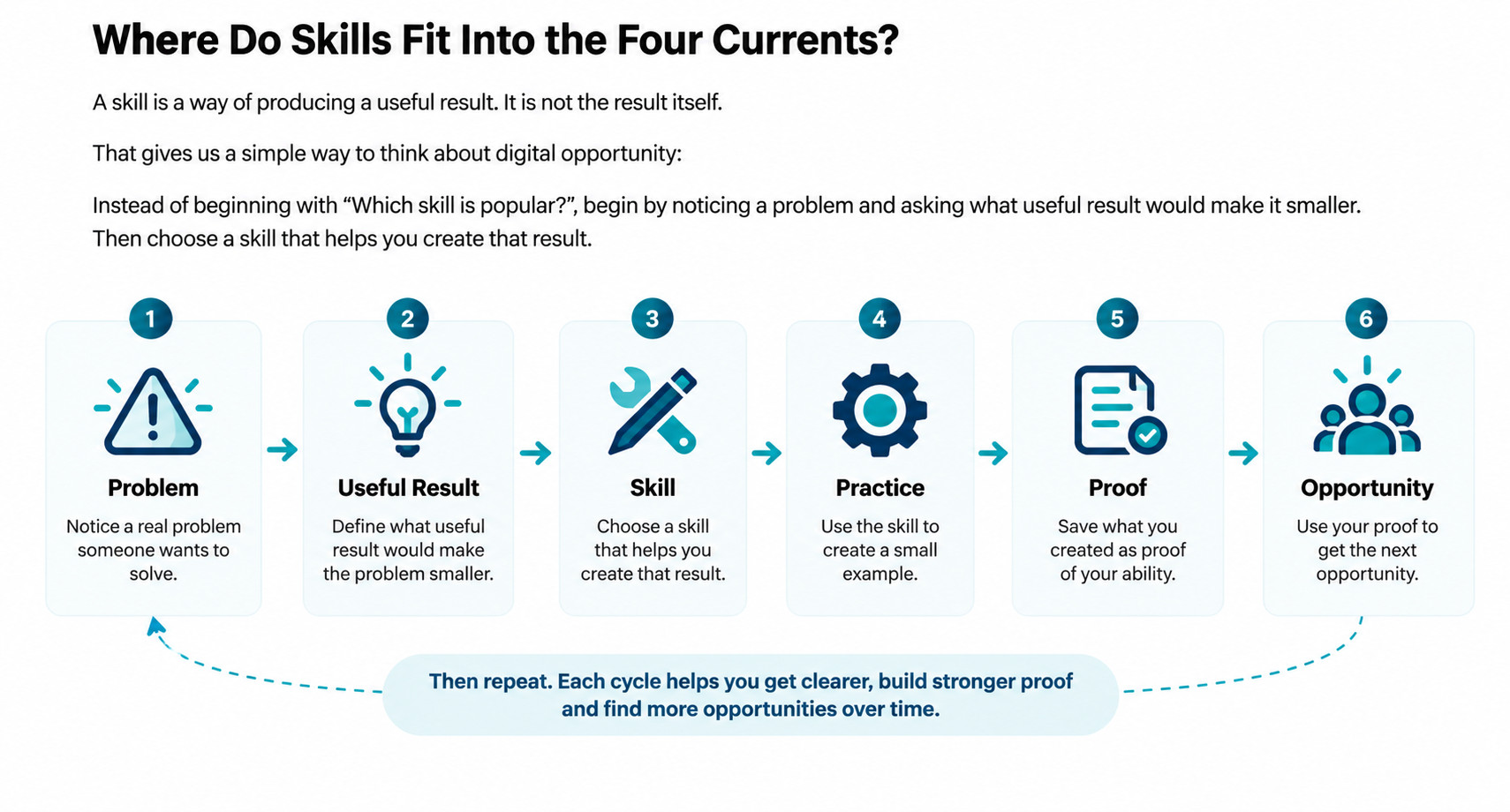
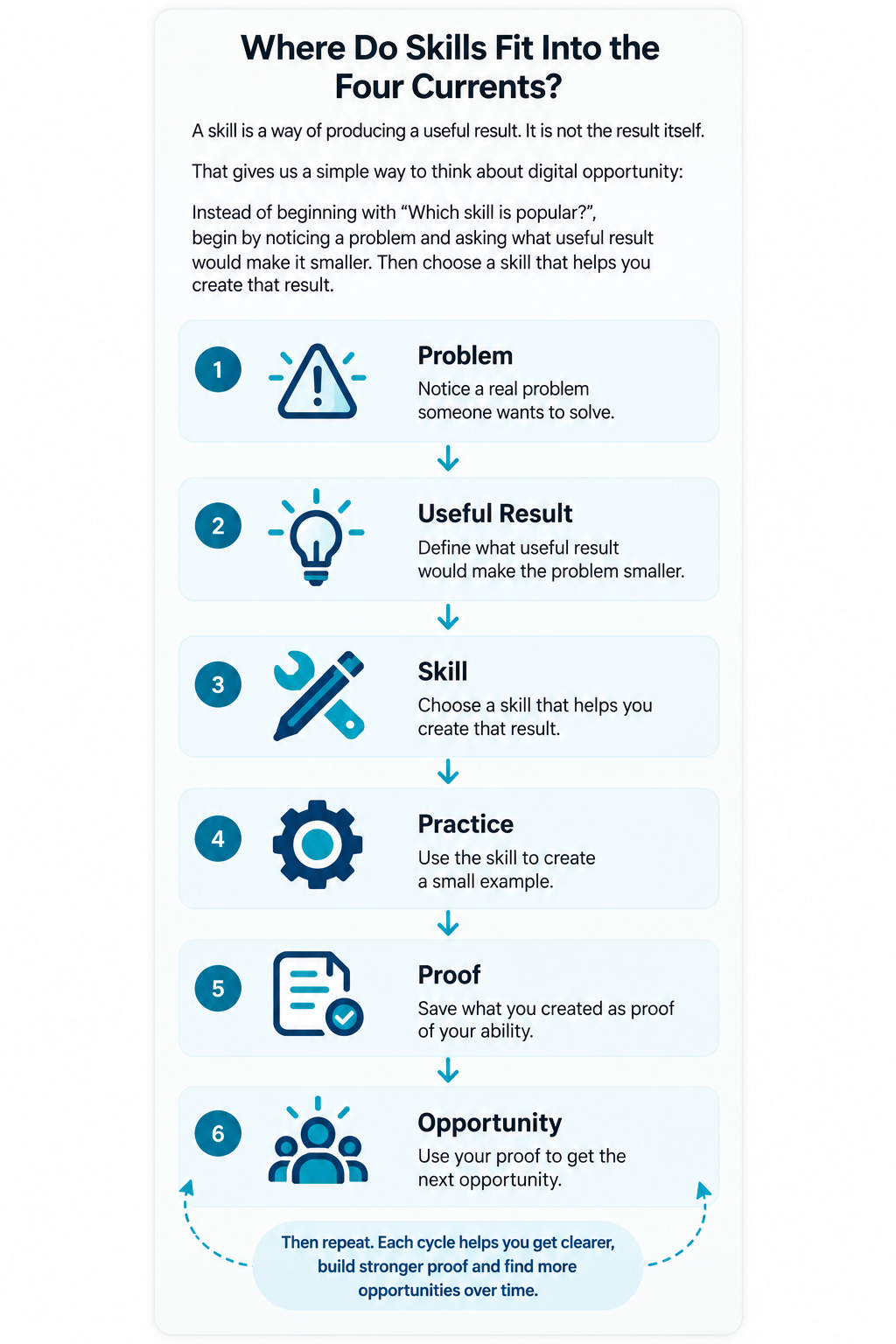
That small result can become practice. Practice can become proof. And proof gives you something concrete to show when an opportunity appears.
This is how a Current begins turning into a path:
Notice a Problem → Create a Useful Result → Save the Proof → Repeat
You are no longer trying to predict your entire future. You are testing where you can become useful.
You Don’t Have to Stay in One Current
The Four Currents are not boxes.
As your skills grow, you may move between them or combine them.
A content creator might use Attention to help ideas get discovered, Value to make those ideas clearer, and Acceleration to build a faster publishing workflow.
A virtual assistant might begin in Operations, then discover opportunities in automation, research, customer experience or project coordination.
The point is not to label yourself.
The point is to notice where problems exist, understand what useful result is needed, and learn how to create it.
From the Four Currents to Your First Opportunity
Once you begin seeing digital work through the Four Currents, the internet starts looking different.
Instead of seeing hundreds of unrelated job titles, tools and income ideas, you can begin asking:
- What problem exists here?
- Which Current does it belong to?
- What useful result would make the problem smaller?
- What skill could help me create that result?
- How could I practice it and build proof?
That is the bridge between learning something and becoming useful with it.
Frequently Asked Questions
What are the Four Currents of digital work?
The Four Currents are a way of understanding digital work by the useful result it creates rather than by job title. They are Attention, Operations, Acceleration and Value.
What is the Attention Current?
Attention is work that helps something useful get discovered, noticed or understood by the right people. Examples can include content creation, search visibility, audience research and distribution.
What is the Operations Current?
Operations is work that helps information, tasks, communication and processes stay organized and keep moving. Examples can include virtual assistance, customer support, research, documentation and project coordination.
What is the Acceleration Current?
Acceleration is work that helps useful work happen faster, more simply or with less unnecessary effort. Automation, AI-assisted workflows and process improvement can support this Current.
What is the Value Current?
Value is work that helps something become clearer, more useful, more trusted or more valuable. This can include improving messaging, offers, customer experiences, information or decisions.
Can one skill belong to more than one Current?
Yes. The same skill or tool can support different Currents depending on the problem being solved and the useful result being created. The Four Currents describe the result of the work, not permanent job categories.
Which Current should a beginner choose?
You do not need to choose one permanently. Start by noticing which kinds of problems you naturally understand or enjoy solving, then test that direction by creating one small useful result.
You Don’t Need to Understand the Whole Ocean at Once
Start by learning to recognize the Current underneath a problem.
Then create one useful result.
Save the proof.
And let what you discover guide your next step.
If you want the larger map connecting skills, problems, proof and opportunity, continue with the free Digital Ocean Opportunity Map.